Woven or Knitted: Two Different Ways Cloth Takes Shape
Woven or knitted fabric behaves differently because its structure affects stretch, drape, and sewing. Learn what to inspect so you can choose cloth for its intended use.
Woven or knitted fabric can change how a shirt moves, how a curtain hangs, and how an edge behaves under a sewing machine. To choose cloth for an object, inspect the yarn structure, then compare the sample’s stretch, recovery, texture, and drape with the shape and use you have in mind.
Read the construction
Woven cloth is made from two sets of yarns crossing one another. The lengthwise yarns are the warp; the crosswise yarns are the weft. In plain weave, as in many cotton shirtings, each yarn alternates over and under its neighbors. Twill, found in many denims, shifts the crossings to form diagonal ribs.
Knitted cloth is made from linked loops. A hand-knitted sweater makes these loops easy to see, while machine-knit jersey uses the same basic structure at a finer scale. The loops can flex and change shape, which often lets a knit stretch even without elastic fiber.
The difference is like a crossing grid beside a chain of linked loops: both make a surface, but the linked form can flex more readily than firmly interlaced crossings. That construction is one part of an object’s material culture—the choices in making cloth shape how people can use and care for the things made from it.
Inspect the fabric face
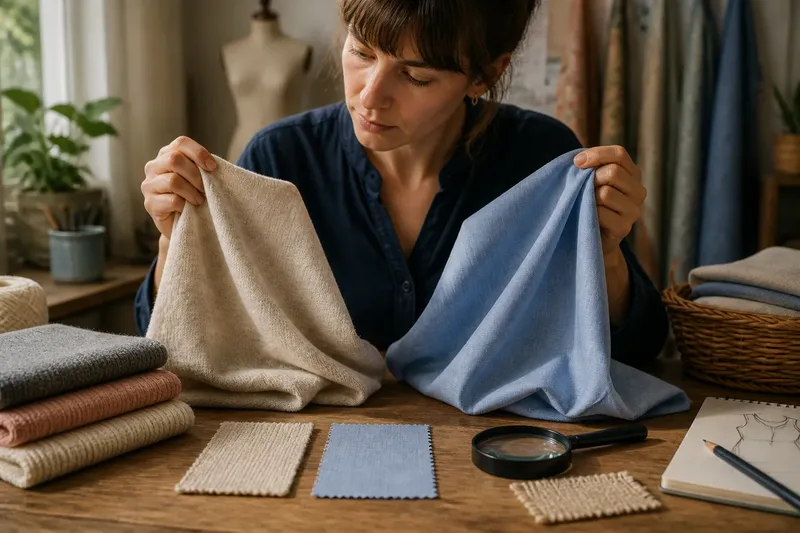
Look closely at both sides of a sample. Plain-weave cloth may show a tiny checkerboard of yarns; twill often has diagonal lines. A magnifier or strong lamp can help reveal the paths in a fine weave.
Jersey knits commonly show small V shapes on the face and bumps or short horizontal bars on the reverse. Rib knits have raised vertical columns, while interlock can look smooth on both sides. A fuzzy finish, print, pile, or coating may hide these clues, so check an unfinished edge or cut sample if available.
Appearance gives a clue, not a final answer. If the surface conceals the yarn paths, turn the fabric over and see whether the edge or movement confirms what you think you see.
Compare stretch and recovery
Hold a sample at opposite edges and pull gently across its width, then along its length. Woven fabric usually yields less, though a bias cut can stretch diagonally as its yarn crossings tilt. Knits often give more across the width; some stretch in both directions. Stitch structure, yarn, and added elastane all affect the result.
Release the fabric and watch whether it returns close to its earlier shape or remains extended. Recovery means a material’s ability to return after stretching. It matters when a garment or object will be pulled repeatedly, but a hard tug can distort a sample and tell you little about ordinary use. Use a light, consistent pull like the one the finished piece is likely to experience.
For a useful comparison, test both samples in the direction that will bear strain. If the cloth will form a garment sleeve, for instance, compare the crosswise give where an arm needs room rather than relying on a pull along the length.
Notice hand and drape
“Hand” means the way fabric feels and responds in your hands. A dense woven canvas may feel firm and hold an edge; fine cotton poplin may feel smooth and light. Knits vary too: thin jersey can fold softly, while bulky rib can feel springy. Fiber, yarn thickness, density, and finishing all influence hand, so “woven” and “knitted” do not name one fixed texture.
To compare drape, support each sample at one edge and let the rest hang. Notice whether it forms broad folds, small ripples, or a fairly straight panel. A fluid jersey may fall close to the body, while a stable woven may hold a clearer outline. A heavy knit can hang in long folds, however, and a lightweight woven can flutter. Construction is a clue, not a complete prediction.
Scrunch and release each sample as well. A cloth that keeps sharp creases may suit a structured shape; one that relaxes into soft folds may suit a piece meant to move. Like choosing between a flexible paper bag and a firm folder, the useful quality depends on what the finished object must do.
Match cloth to use
A knit’s stretch can help a close-fitting T-shirt move with the body. A stable woven may suit a crisp shirt, table napkin, or panel that needs a clear edge. These are starting points rather than rules: a woven garment can gain room through its cut, and seams or backing can stabilize a knit.
Consider edge behavior before sewing. Many knits curl at cut edges or stretch under a presser foot; many wovens fray as yarn ends loosen. A stretch stitch may suit a knit hem, while an enclosed seam or overlocked edge can contain a woven’s loose yarns. Check that your machine, needle, and finishing method are suitable for the specific cloth.
Say you are choosing fabric for a loose summer top. The starting options are a cotton jersey and a lightweight woven lawn, and the intended result is a soft top that allows easy movement. Pull both gently across the width, release them, and let each hang from your hand. If the jersey gives more and settles into folds that suit the shape, it is the stronger candidate; if the lawn’s steadier outline better matches the design, choose it instead. The tradeoff is mobility against a more defined shape, not a universal ranking of the fabrics.
Which fabric questions matter?
Can woven fabric stretch?
Yes. A bias-cut woven can give diagonally, and some woven cloth includes elastic yarn. Check the direction and amount of movement in the actual sample before choosing it for a close-fitting or flexible use.
Does every knit stretch alike?
No. Jersey, rib, and interlock have different loop arrangements, and yarn content also affects their behavior. Test the sample in the direction the finished item will pull.
Which structure is easier to sew?
Neither is always easier. Wovens often stay stable under a sewing machine but can fray; knits can stretch or curl at the edge and may call for a stretch-capable stitch. The suitable choice depends on your equipment and the finish the object needs.
Can appearance identify the structure?
Sometimes, but a fuzzy surface, print, or coating can conceal the yarn path. Inspect the reverse or a cut edge, then compare gentle stretch and drape before deciding.
Make a considered choice
When choosing woven or knitted fabric, use a simple decision check: if you can see interlaced yarns, treat the sample as woven; if you see linked loops, treat it as knit. If the surface hides the structure, inspect the reverse or edge; if that still leaves doubt, compare gentle stretch and drape rather than relying on appearance alone. Then check recovery, hand, and edge behavior against the object’s intended shape and use. This material-culture perspective connects how cloth is made with how an everyday object is handled, maintained, and valued.