Before the Keepsake Box: Where Small Treasures Were Kept
Where small treasures were kept depended on habit and furniture: follow an imagined family’s objects from a worktable drawer to a cabinet and beyond.
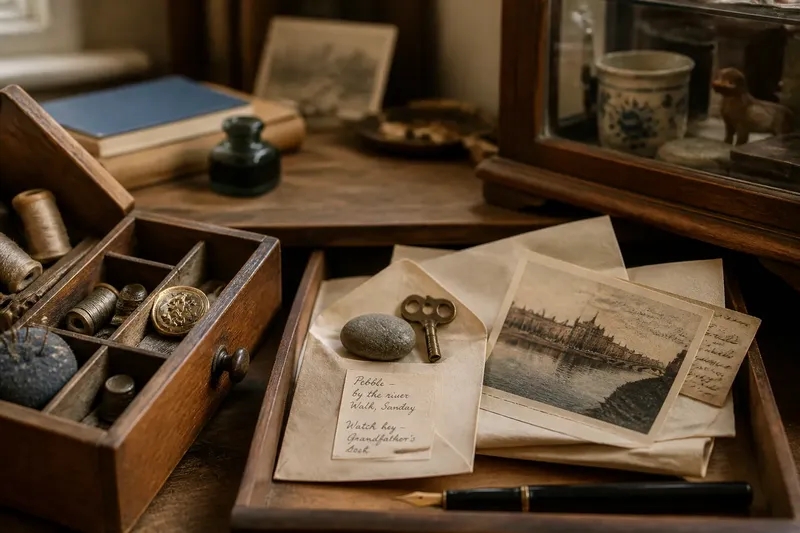
Where small treasures were kept depended less on a special box than on the furniture and habits already at hand. Imagine a household sorting a modest group of keepsakes: a brass button, a smooth pebble, a paper ticket, a broken watch key, and a postcard with a faded view. Their changing storage places reveal how ordinary rooms made room for objects too small to use every day but too meaningful to discard.
This is an invented situation, not a historical case record. The household has no dedicated keepsake chest at the outset. It has a sewing table, a writing desk, a dresser, and a glass-front cabinet. As the family moves the objects through those spaces, each container changes what can be seen, reached, remembered, and passed on. The point is not that every household followed this sequence; it is that storage often grew from practical furniture before it acquired a name of its own.
Useful Things First
The brass button begins in a shallow compartment of the sewing table. It came from a coat that is no longer worn, but the household keeps it with spare hooks, thread, and needles because it might prove useful. This is storage by category: objects stay with materials that share a task, even when their original purpose has ended.
The compartment is not a keepsake box in the familiar sense. It was made to keep sewing supplies separated and easy to retrieve. Its dividers prevent a small button from disappearing under a spool, while the table’s location makes it convenient during mending. The object’s sentimental meaning exists, but the furniture has not yet been reorganized around that meaning.
Small belongings commonly drift between use and remembrance. A button might remain a spare part, become a reminder of a garment, or serve both roles at once. The storage place can preserve this uncertainty. A drawer allows the household to keep the object without deciding whether it belongs in a collection.
That distinction matters when looking at old storage. A small object in a tool drawer was not necessarily overlooked. It may have been kept close to a practical activity, where the owner expected to encounter it again. The container tells us something about access, but it cannot by itself tell us exactly what the keeper felt.
Drawers Make Categories
The pebble and watch key turn up in the writing desk. In the imagined household, the pebble was picked up during a walk and set down beside a letter; the watch key came from an older relative’s desk. Neither belongs to the paperwork, yet a desk drawer offers a useful halfway place: private, nearby, and less likely to be disturbed than the open surface.
A drawer is a simple sorting device. Its contents are hidden when shut, but they are available to someone who knows where to look. Unlike a box that can be lifted and carried away, a built-in drawer is tied to a room and a piece of furniture. Its depth, dividers, and position shape the collection it can hold.
In this case, the family places the pebble and watch key in a small paper envelope inside the drawer. The envelope keeps them from rubbing against pens and clips, while a penciled note identifies where they came from. The note is not an elaborate catalog; it is a practical aid for a future person who may recognize the objects but not their stories.
Imagine that one household member later moves the pebble to a bedside table because it feels pleasant to hold before sleep. The observable result would be a change in how often the pebble is handled, not proof of a universal custom. This small shift shows that storage can follow an object’s use, and that use can be quiet: touching, looking, or keeping something within reach.
Drawers also make boundaries. A desk drawer can separate private tokens from shared household goods, while a dresser drawer can gather personal items such as ribbons, letters, or keepsakes from a particular relationship. Such divisions are not fixed rules. They are created through repeated placement and understood by the people who use the furniture.
Paper Protects and Explains
The postcard changes the group’s storage problem. It is flat, fragile at the corners, and carries writing that the household does not want rubbed away. A drawer is still suitable, but placing the postcard loose among metal objects could bend or abrade it. The family slips it into a folded sheet of clean paper and keeps it with the envelope.
Paper wrappers and envelopes often serve as modest containers within larger ones. They divide objects without requiring new furniture, and they can carry a name, date, or short explanation. A folded paper cover is like a paper sleeve around a book: it limits contact while leaving the object easy to retrieve. It is not a substitute for careful handling, but it can make a mixed drawer less disorderly.
The postcard also illustrates how writing can preserve context. The family adds a brief note identifying the place shown and the person who brought it home, based on what they already know. If they do not know a detail, they leave it unfilled rather than turn a guess into a fact. A later keeper can distinguish the object’s visible features from the family’s remembered account.
Storage choices for paper depend on its condition and on the material around it. If an item is brittle, stained, or valuable, a conservator or archivist can advise on suitable enclosures and handling. For ordinary household material, the broader lesson is to avoid forcing a paper object into a container that bends it or presses it against rough edges.
When Should Small Treasures Move?
Does a keepsake need its own box?
No. A drawer, envelope, or compartment can serve well if it protects the object and makes its location understandable to the people who keep it. A purpose-made box becomes useful when the collection needs a container that can be moved or kept together.
Why keep objects out of sight?
Hidden storage can protect small items from dust, casual handling, and loss in a busy room. It can also reflect privacy or the simple wish to keep a surface clear, rather than a lack of affection for what is stored.
When does a display cabinet make sense?
A cabinet suits objects the household wants to see without handling constantly, especially when they have a stable place on a shelf. Glass changes the relationship: it makes items visible while adding a barrier between them and routine use.
How can a future keeper identify an object?
Keep a short, separate note with the object or its enclosure, naming what is known and who supplied that information. Avoid writing directly on delicate surfaces, and leave uncertain details clearly uncertain.
The Cabinet Changes the Audience
In the invented household, the family eventually brings the pebble, button, watch key, and postcard together in a small tray inside the glass-front cabinet. The cabinet already holds a few ornaments and books. The tray gives the objects a shared place, while the glass lets family members notice them without opening a drawer.
This move changes more than protection. A drawer is usually opened by someone who knows to search it; a cabinet can make a collection visible to visitors and other household members. The keepsakes become part of the room’s appearance. Their arrangement now communicates that they belong together, even though their original uses and stories differ.
Display can invite conversation, but it can also flatten distinctions. The brass button may have been a useful spare, while the pebble began as a found object and the postcard as correspondence. Placing them side by side gives them a new shared identity as family mementos. That identity is real as a household choice, though it does not erase the objects’ earlier roles.
The family adds a small card beneath the tray with names and brief notes. It does not claim more than they know. The card helps a visitor ask about the objects and helps a child in the household connect an item with a person or place. If the arrangement changes later, the notes can travel with the tray rather than being mistaken for labels attached permanently to each object.
A glass cabinet is not automatically safer than a drawer. Dust can enter, sunlight can fade paper, and shelves can make small objects easy to knock when the door is opened. Where the cabinet sits and how often its contents are handled matter. The household chooses an interior shelf away from a sunny window and keeps the postcard in its paper enclosure, balancing visibility with care.
From Collection to Inheritance
Time passes in the imagined story, and the furniture changes owners. The sewing table goes to one relative; the writing desk remains in the house; the cabinet is moved to another room. These changes expose a weakness in storage that depends entirely on furniture: a drawer’s meaning may be obvious to its regular user and opaque to someone who inherits the desk.
The family therefore keeps a plain inventory with the cabinet’s contents. It names each object and records the known connection in simple language: the button came from a coat, the pebble from a walk, the key belonged to an older relative, and the postcard was brought home from the place pictured. The inventory does not need elaborate descriptions. Its purpose is to keep the objects from becoming anonymous when the original storytellers are absent.
This is where a purpose-made container may become useful. A small box can keep a group together during a move, while a label or accompanying note preserves the relationship among its contents. The box does not create their meaning; it makes the grouping portable. If the objects are stored separately because their materials need different care, a shared inventory can still link them without putting them all in one container.
For someone sorting inherited belongings, the first useful question is not whether an object deserves to be called a keepsake. Ask what it is made of, what condition it is in, whether it carries writing or other context, and who may know its story. Then choose a place that suits those facts: a compartment for a small durable item, a paper enclosure for a flat document, or a cabinet for a stable object the household wants to see.
Where small treasures were kept was often an answer made from available furniture, a keeper’s habits, and the wish to protect or revisit particular things. The box associated with keepsakes is only one possible ending. A labeled drawer or a cabinet tray can preserve more than the objects themselves when it keeps their names, relationships, and uncertain stories close at hand.